|
Squad - Shun!
The CCF at WLHBS in the
60's- by John Swash
Read this article in conjunction with the
CCF photos
|
|
The Combined Cadet Force (CCF)
was formally founded in 1948. It was created by combining existing
school-based military cadet units from the Royal Navy, Army, and
Royal Air Force into a single organisation.
The WLBHS cadet force was originally inaugurated in 1941 during
the Second World War, alongside the construction of the school's
air-raid shelters. By the 1950s and early 1960s, the contingent
operated both Army and Air Force sections out of two dedicated wooden
huts, as well as a CCF amateur radio room inside the old Kindergarten
building.
The corridor between the school basement and the air raid shelter
served as the armoury. With racks for about 30 Lee Enfield .303
bolt action rifles, a couple of Bren guns and if memory serves me
correctly a Vickers Machine gun. I doubt whether any live ammunition
was kept at the school. [How
times have changed; in a modern state school, the idea of a teacher
facing a class armed with rifles and fixed bayonets is almost unthinkable.
]
|
|
Life as a Cadet in the 1960s
At West Leeds, all cadets completed two
or three years of basic training in the Army section. Upon entering
the sixth form, students had the option to swap their khaki uniform
for RAF blue by transferring to the RAF section.
Corps Day
and Weekly Training:
Once a week on "Corps Day," cadets attended normal school
lessons in their khaki uniforms and heavy army boots. After the
final bell, we would file out and muster on the playground-which
doubled as our parade ground-for weekly drill. This "square
bashing" would have looked very familiar to anyone who did
National Service, as well as to our fathers and grandfathers who
served in the two World Wars. When the weather was bad, drill moved
indoors to the school hall.
On other weeks, we had classroom instruction in fieldcraft, map
reading, and handling the Lee-Enfield .303 rifle-practising until
we could reload and change the ammo magazines with our eyes shut.
Ceremonial Occasions: Uniforms
were also worn all day-and into the evening at Leeds Town Hall-for
Speech Day every November. We also put our parade drill into practice
when marching four abreast in a column through the streets of Armley
for the annual school service at Christ Church, Upper Armley. Needless
to say, we had to be well turned out for these occasions, with uniforms
pressed and boots and brass buckles gleaming.
Annual Camp:
A highlight of the school year was the mandatory week-long summer
camp, which immersed cadets in regular military life. Travelling
by coach or train to active service bases, students swapped the
classroom for intensive training tailored to their section.
Army cadets tackled gruelling field exercises and live firing on
the range with .303 rifles, while the RAF section headed to RAF
stations for technical instruction, gliding, and flight training
in Chipmunks or experience flights in an Avro Anson.
Some of the regular locations included:
Strensall Army Camp (North Yorkshire)
Being relatively local, Strensall was used for both weekend range
days and longer summer camps for live firing on the .303 ranges.
Cultybraggan (Scotland) A former POW camp used as a base
for Scottish summer camps.
RAF Manby (Lincolnshire) The RAF section spent a week here
taking part in technical workshops and gaining flying experience
in Chipmunks.
Langbar (Near Ilkley) West Leeds cadets often used this rugged,
hilly terrain for tactical training and "manhunt" exercises.
On one memorable exercise near Ilkley, we were driven out in a closed
Army truck and dropped off at intervals in groups of three with
nothing but an OS map and a list of objectives. We had to figure
out our location and navigate a route back to the pickup point via
three checkpoints, collecting specific details along the way-such
as the date carved over a farm cottage door. We didn't see any other
of our groups until we arrived back at the rendezvous point , tired
and footsore, but pleased at our achievement.- Everyone got back
to the rendezvous point . Just imagine doing the risk assessment
for this nowadays-what could possibly go wrong! JS
|
|
The Army Section
The Army section focused on traditional infantry skills designed
to prepare boys for potential National Service (which had only recently
ended) or commissions in the Territorial Army.
Drill and Turnout: There was a heavy emphasis on ceremonial
drill, including "marching in slow time" and properly
"blancoing" webbing by applying green or khaki paste to
canvas belts and pouches. We used Brasso to polish cap badges and
buttons, and faced the ultimate challenge of spit-polishing black
leather boots until you could see your face in them-fortunately,
I had an uncle who was a former WW2 Sergeant Major who taught me
how to do this.
Skill at Arms: Cadets received extensive training on the
.303 Lee-Enfield rifle and the Bren light machine gun, mastering
the art of stripping and assembling both weapons blindfolded.
Marksmanship Shooting practice took place at regional ranges such
as Strensall or Otley Chevin.
Fieldcraft Training: covered "stalking" (moving
undetected), "fire and manoeuvre" tactics, and building
temporary shelters ("bashers") out of ponchos and string.
Navigation: Cadets practised advanced map reading using Ordnance
Survey maps, alongside learning how to use a prismatic compass and
navigate by "dead reckoning" at night.
|
|
The RAF Section
The RAF section at West Leeds was particularly popular due to its
technical curriculum and access to specialised equipment housed
in the wooden "kindergarten" hut.
Aero-Engines and Principles of Flight: Theoretical lessons
covered lift, drag, and the mechanics of internal combustion engines.
Aircraft Recognition: In a legacy of WWII training, cadets
were drilled to identify friend-from-foe aircraft purely by their
silhouettes.
Signals and Communications: Using the ham radio set up in
the school's old Kindergarten building, cadets learned both Morse
code and the phonetic alphabet.
Air Navigation: Training included plotting courses using
"dead reckoning" alongside basic meteorology to understand
wind speeds and cloud formations.
Flight Experience: The highlight was Air Experience Flights
(AEF) at local RAF stations, where cadets flew in Chipmunk aircraft
and were occasionally allowed to take the controls.
|
|
Officers
( Masters and Commanders)
The officers in the CCF units were our own school teachers-many
of them ex-military who held commissions in the Volunteer Reserves.
In a very real sense, our form masters were our commanders. Former
pupils from the 1960s still recall several of them:
Capt. Grey (German and French Teacher) He once confided that
he saw service at the end of WWII and honed his German language
skills interrogating prisoners during the post-war period.
Mr Mounsden (Art Teacher) An officer in the RAF Section who
taught aircraft recognition and principles of flight. Famously dapper,
he is often remembered as a classic "Brylcreem Boy" type.
Mr J. H. Duncan (Chemistry Teacher) Known for his intense
passion for aviation, he ran the Air Cadets and famously kept a
large Spitfire propeller in his lab prep room as a visual aid for
lessons.
Mr Lloyd (Geography Teacher) He was involved in fieldcraft
and navigation for the Army section, putting his subject expertise
to good use teaching cadets how to read Ordnance Survey maps.
Major A. D. Firth (Maths Teacher) Recalled as a commanding
presence who dealt out discipline fairly and upheld the strict military
standards of the Army section.
|
|
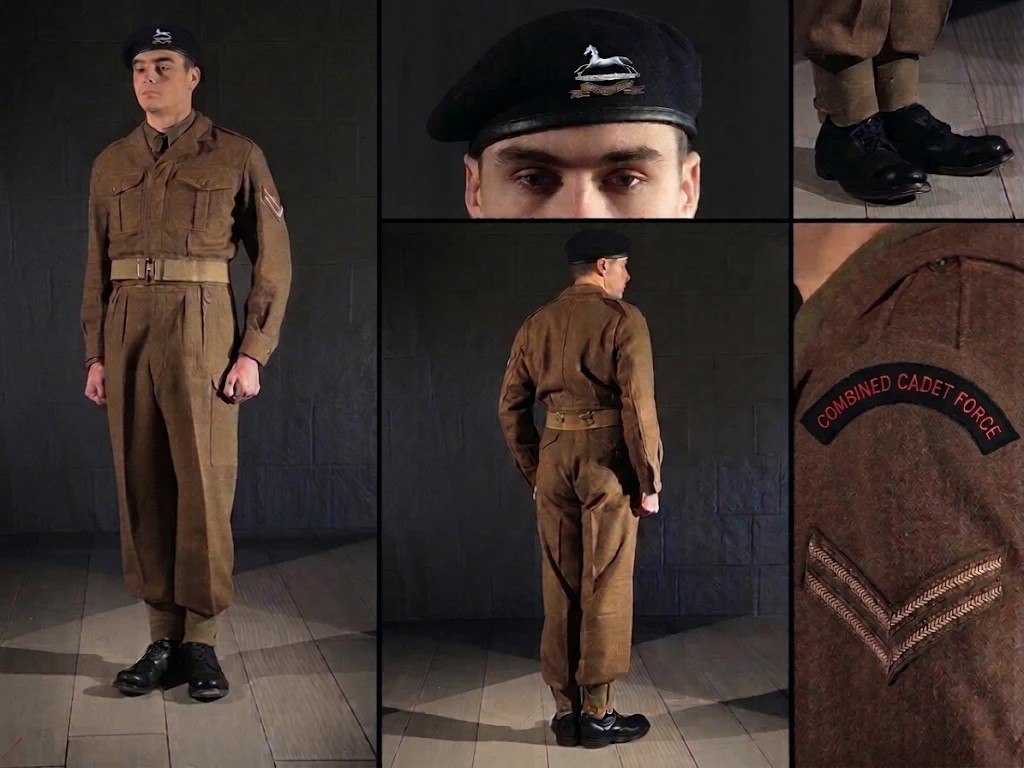
The Uniform ( See Photo below)
If you volunteered for the CCF, you got to wear not one, but two
uniforms at school. For the West Leeds Boys' High School (WLBHS)
Army section in the 1960s, the kit was a mix of rigid military tradition
and rugged post-war surplus.
The Main Uniform: Most cadets wore the 1949 Pattern Battledress,
a thick, woollen khaki outfit consisting of a short blouse jacket
that buttoned tightly at the waist with two large breast pockets
and a collar worn with a khaki shirt and tie. The matching trousers
were high-waisted and baggy, featuring a large "map pocket"
on the front left thigh and a dressing pocket on the right hip,
finished off with blancoed gaiters fastened by brass buckles.
Webbing and Equipment: Cadets were issued 1937 Pattern Webbing,
a system of canvas belts and pouches. Although the canvas was naturally
light tan, we had to apply "Blanco" (a compressed block
of green / khaki pigment) to give it a uniform service finish. Every
buckle and tip on the webbing was solid brass and had to be polished
with Brasso until it shone, without leaving any polish residue on
the canvas. During field exercises, we might also wear a small pack
on our backs to carry a poncho, mess tins, and dry rations.
Insignia and Patches A cadet's sleeve told the story of their
rank and skills. At the top of the arm sat embroidered shoulder
"flashes" reading WEST LEEDS in red or white lettering
on a black or dark green background, with a small rectangular "C.C.F."
patch directly beneath. Rank chevrons were worn on the upper right
arm (and sometimes both)-one stripe for Lance Corporal, two for
Corporal, and three for Sergeant. Cadets also wore small four-pointed
proficiency stars for passing Certificate 'A' exams, while those
who excelled on the shooting range earned a pair of crossed rifles
sewn onto the lower sleeve.
Headgear and Footwear: We wore black berets pulled sharply
to the right, with the Prince of Wales's Own Regiment of Yorkshire
cap badge positioned over the left eye. On our feet were heavy black
leather ammo boots with hobnailed soles; the toe caps were "spit-polished"
using beeswax, spit, and a hot spoon to achieve a glass-like shine.
Officers would occasionally conduct kit inspections, where any dust
on the webbing or a dull toe cap meant extra drill on the playground.
By contrast, those who transferred to the RAF section had a much
easier time with their blue uniform; it followed a similar style,
but there were no gaiters or brass buckles to polish, and standard
black shoes could be worn instead of heavy army boots.
|
 |
|
The West Leeds CCF:
My Part in Its Downfall
I was there at the end. When the Combined Cadet Force (CCF) at West
Leeds Boys' High School was finally disbanded in 1964, it wasn't
down to any heroic military defeat-it was really a mix of falling
numbers, the end of conscription, and everyday staffing pressures.
Once National Service finished in 1963 and the Ministry of Defence
made cadet membership strictly voluntary, far fewer boys chose to
sign up, leaving many school units too small to keep their official
grants. Because municipal grammar schools relied on regular teachers
giving up their spare time to run the Army and Air Force sections,
our contingent was eventually disbanded as key staff moved on and
the school shifted its focus toward academic life and other clubs.
Handing Back the Kit Personally, I was sad to see it go. I still
remember handing in my army uniform to the grizzled, hard-as-nails
sergeant major who, thankfully, was not a teacher at the school.
Having joined the cadets in my second year and spent three years
in the Army section, I had been looking forward to swapping my khaki
for RAF blue in the sixth form and finally getting the chance to
experience flying at annual camp.
Final oders: "Squad-'shun" "Dismiss"
|
|